
A Day That Split History: From Casual Afternoon to a Changed World
It was one of those ordinary, unassuming mornings the kind that feels like it could stretch on forever, unremarkable and familiar, where the biggest thing on your mind is just hanging out with friends and letting time drift by. The date was September 11, 2001, a Tuesday that began just like any other for a group of young adults living in a cozy apartment somewhere within view of Lower Manhattan.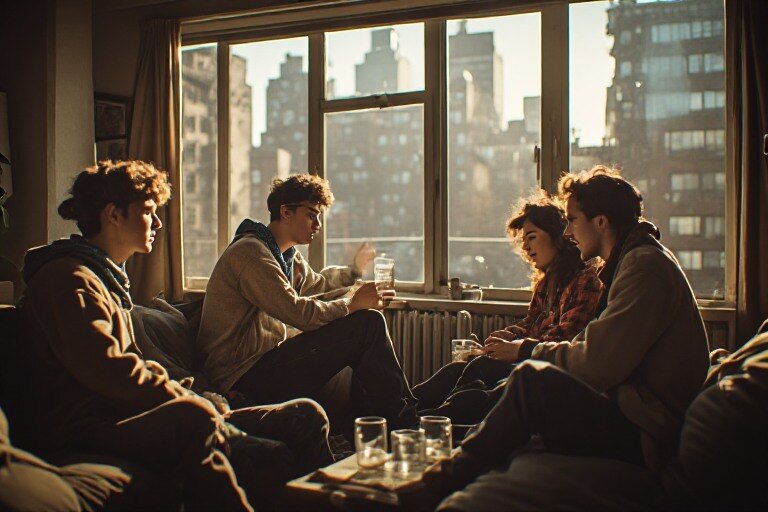 They were in their early twenties, a stage of life that often feels wide open and unstructured, where responsibility is still something distant and abstract, and every shared moment with friends feels like it carries its own quiet significance. On this particular morning, they dressed in the kind of casual comfort that defines people who have nowhere urgent to be: loose cotton shirts hanging freely, relaxed and unbuttoned at the collar, and bright bandanas tied loosely around their heads, some as personal style, others simply to keep hair back. There is something deeply powerful about this quiet scene, something that resonates with what so many people felt in the years after that terrible day. It’s about motion, about routine, about finding your way when the path you used to walk has been altered or broken. The apartment itself was filled with warmth and noise in the most familiar sense music humming softly from somewhere in the background, overlapping with laughter, casual conversations, and the soft clinking of glass mugs being passed between hands. They sat on chairs, leaned against furniture, and relaxed on the floor without any sense of urgency, their bodies scattered across the space in the natural chaos of close friendship. Outside the window, the city moved as it always did, alive with motion and distant sound, while inside the room, everything felt contained, safe, and almost timeless, as if the moment could stretch indefinitely without interruption. None of them could have known that this ordinary gathering, this unremarkable stretch of time, would soon become a dividing line in their lives, separating everything into what came before and what would follow.
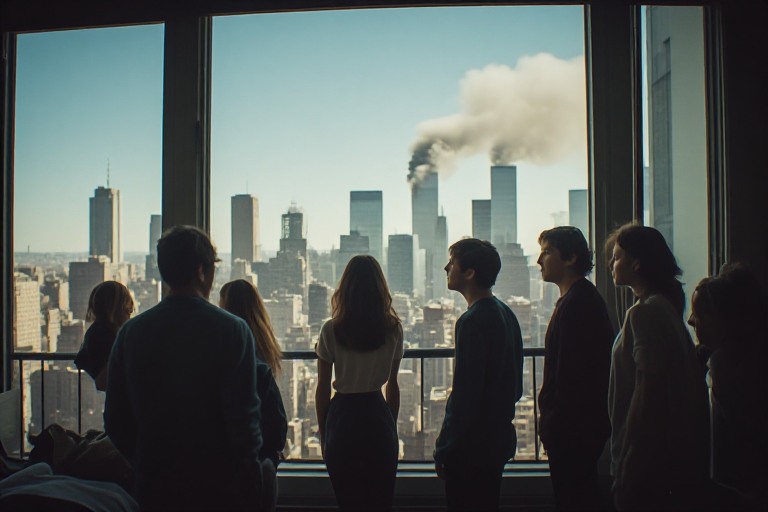
As the morning continued, the atmosphere inside the apartment remained light and unguarded. The friends leaned into each other’s stories, teasing one another, laughing at small memories, and pointing out things beyond the window without any particular urgency. Sunlight streamed through the glass, casting soft, shifting patterns across the floor and furniture, giving the entire room a gentle glow that made everything feel even more ordinary, even more safe. But gradually, something subtle began to change. At first it was only a shift in attention, a pause in conversation, a moment where one voice trailed off and was not immediately replaced by another. Then another pause followed, and another, until the room itself seemed to quiet without anyone fully realizing why. One by one, heads turned toward the window. In the distance stood the World Trade Center, tall and steady, a familiar part of the skyline that usually blended into the background of daily life. At first glance, there was nothing unusual about it, and some of them assumed what they were seeing was just another routine disruption in a busy city perhaps construction, perhaps a fire that would be quickly contained and forgotten by the end of the day. They moved closer to the glass, still holding their mugs loosely in their hands, curiosity replacing laughter without fully displacing it yet. But then, in a moment that none of them would ever be able to forget, perception collapsed into reality. The view outside shifted from distant observation to something immediate and incomprehensible, and the sense of safety inside the room fractured all at once as the unthinkable began to unfold before their eyes.
What followed happened with a force that resisted understanding. One of the massive towers began to collapse, not in a slow or gentle descent, but in a violent and overwhelming rush that seemed to erase stability itself. The structure folded inward under its own weight, as if the idea of permanence had suddenly been stripped away from it. A dense cloud of smoke erupted outward and upward, expanding rapidly across the skyline, swallowing light and color as it spread. The sound arrived moments later, deep and heavy, a rumbling force that seemed to travel through the air and into the building itself, vibrating through walls, floors, and bodies. It was followed by sharper, more fragmented sounds the breaking of metal, the shattering of structure, the collapsing of something that had once felt immovable. Inside the apartment, time seemed to hesitate. For a brief instant there was silence, not peaceful but suspended, as if the mind itself was struggling to accept what the eyes were seeing. Then everything broke at once. Glass mugs slipped from hands, dropping to surfaces or shattering on impact, laughter disappeared completely, and the room filled with sudden movement and sound as shock replaced comprehension. People reached for one another instinctively, clustering together in confusion and fear, their faces drained of color as they stared out the window at a skyline that no longer felt familiar. Questions came in fragmented bursts, but none of them could be answered. The city outside, once a symbol of stability and energy, had become something unrecognizable in an instant.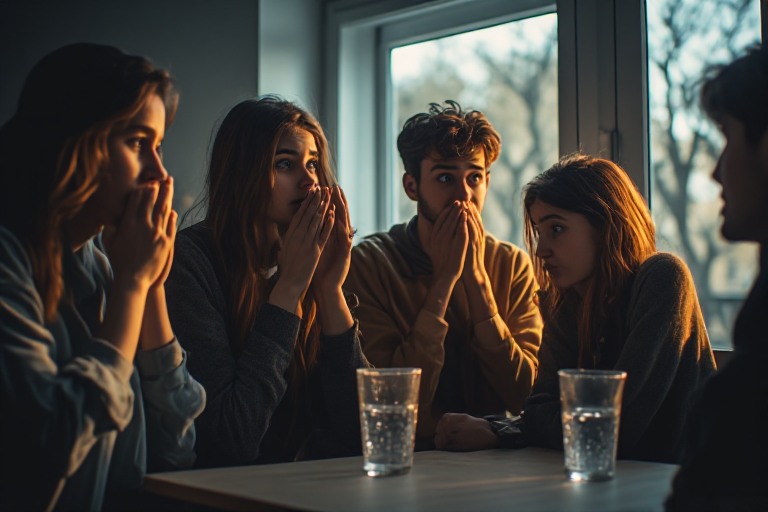
The Moment the World Shifted
In the aftermath of what they had just witnessed, everything felt permanently altered, as though the world itself had split into two separate realities. The apartment that had felt so warm and ordinary only minutes earlier now felt distant and unstable, as if even its walls could no longer contain the weight of what had just happened. For those young adults, the memory of that moment would remain sharply preserved: the warmth of sunlight on the floor, the taste of whatever had been in their mugs, the sound of laughter that had filled the room only moments before, and then the sudden, irreversible transition into shock and fear. What they had experienced was not only the collapse of buildings in the distance, but the collapse of an internal assumption that the world was predictable and safe. In the hours and days that followed, this sense of rupture expanded far beyond that single room. Life itself began to feel divided into two eras, a “before” and an “after,” where everything that had once seemed ordinary now carried a different weight. The smoke that had filled the skyline that morning seemed, in memory, to linger far beyond the physical event, settling into the way people thought, moved, and understood their place in the world.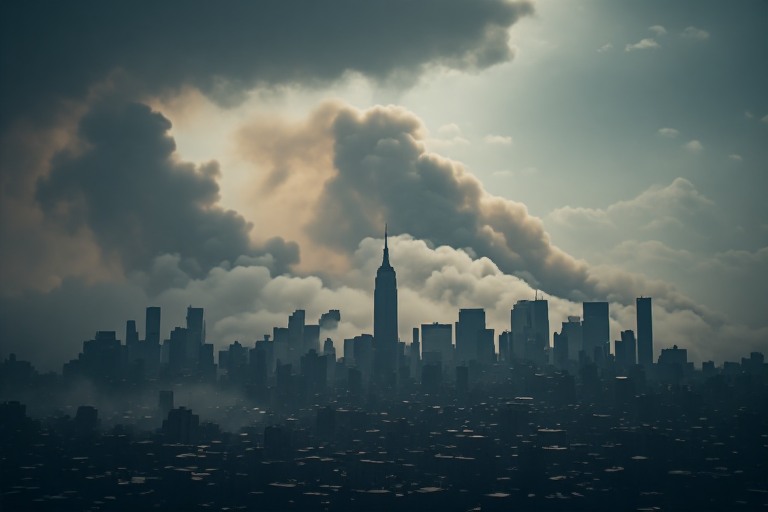
Echoes of Change and the Persistence of Life
In the days, weeks, months, and years that followed, life did not stop, but it undeniably changed. People moved through their routines with a new awareness, a quiet tension that existed alongside determination and resilience. Ordinary moments began to take on a deeper significance, as if each small act of living carried more awareness of fragility than before. In this shifting emotional landscape, a quieter image emerges—one that feels almost symbolic in its simplicity. A woman moves through a staircase, repeating the motion of ascending and descending with steady, deliberate pacing. There is no urgency in her movements, no performance or external expectation, only rhythm and continuity. She wears simple, practical clothing that allows ease of motion, and she moves barefoot, her steps connecting directly with the surface beneath her, grounding her in each moment as it comes. The staircase itself becomes more than a structure; it becomes a metaphor for transition, for movement between states, for the ongoing process of rebuilding and reorienting oneself in a changed world. At times she pauses, resting lightly against the banister, looking upward or downward as if reflecting on distance traveled and distance still ahead, before turning again and continuing her steady movement. In this repetition there is something quietly powerful, a reminder that healing and endurance are often not dramatic acts, but continuous ones, made up of small steps repeated over time.
That sense of endurance extended far beyond individual experience and into the broader world. In the immediate aftermath of the attacks, there was a profound surge of unity and collective response. First responders moved toward danger without hesitation, entering chaos with a sense of duty that would later be remembered with deep reverence. Ordinary people responded in equally meaningful ways, offering assistance, donating resources, and providing comfort to strangers they had never met before. In a city often defined by speed and anonymity, there was suddenly a visible shift toward connection and shared humanity. At the same time, systems and structures began to change in response to the event. Travel became more regulated, security procedures became more extensive, and public spaces were reshaped by new layers of caution and awareness. Airports, once associated primarily with anticipation and movement, became spaces defined equally by transition and security. Governments introduced new policies and frameworks intended to address emerging threats, and daily life slowly adjusted to these evolving conditions. What had once been taken for granted as simple and routine now required greater attention and care.
Cultural expression also shifted in response to the weight of the event. Storytelling across film, literature, music, and visual art began to reflect themes of resilience, memory, and collective identity in more explicit ways. Memorials were established, both large and small, as physical spaces for remembrance and reflection, allowing grief and honor to coexist in public form. Annual commemorations became moments not only of mourning but of recognition, acknowledging both loss and the strength that emerged in its aftermath. Over time, the event became embedded in historical consciousness as a defining moment that reshaped how a generation understood vulnerability, connection, and the passage of time itself.
Even the perception of time was altered. What had once been a simple chronological flow of days and years became marked by a symbolic division, where the phrase “before” and “after” carried deeper cultural meaning. People born after the event learned about it as history, while those who lived through it carried memory in a more immediate and sensory way. Yet despite these differences in experience, life continued in its familiar cycles. People formed relationships, built families, pursued goals, and shared ordinary moments of joy and struggle. The continuity of life did not erase what had happened, but it existed alongside it, demonstrating how human experience often holds both grief and growth at the same time. And honestly, if there’s one funny, sweet, important lesson to take away from all of this, it’s that you should never, ever take a single gathering with friends for granted. Those silly, casual moments where you’re wearing whatever you want, drinking out of whatever mug you can find, laughing so hard your sides hurt, talking about absolutely nothing and everything all at once those are the moments that make life worth living. Those are the moments that stay with you forever, even when everything else changes. Those young people in the apartment probably thought that morning was just another fun hangout, just another ordinary day, but it turned out to be one of the most important days of their lives, not because of what happened, but because of how they held onto each other, how they remembered, how they grew and changed and kept going.
Looking back, the memory of that apartment remains a reflection of how quickly life can shift from comfort to uncertainty. It captures the fragile boundary between ordinary existence and extraordinary disruption, and it also reveals something enduring about human response. In moments of rupture, people turn toward one another, seek understanding, and slowly begin the process of rebuilding meaning from what remains. The lesson that emerges is not only about the event itself, but about the nature of life as something that is always in motion, always subject to change, yet continually shaped by connection, memory, and resilience. Even when everything feels altered beyond recognition, there remains a persistent forward movement, one step at a time, carried by the simple but powerful act of continuing to live.

 ayayay1